
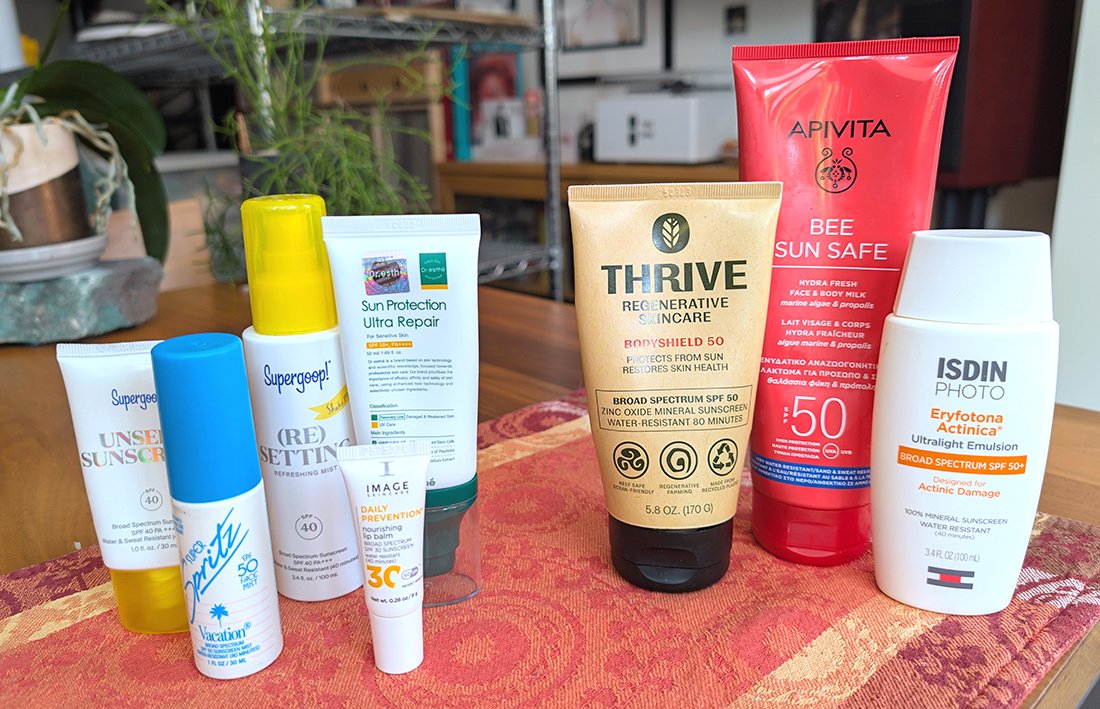
Today it's 85 degrees in SF, sun is shining full-blast, and as Matt was leaving the house for the day, I asked, "do you have sunscreen on?" Nope. Oopsies!
Sunscreen is my non-negotiable skin-care product for going outside (and for airplane travel if sitting by the window - UV rays are super strong in the skies). As you can see from the photo above, I have a drawer-full of sunscreen options, some I prefer more to others. Even on non-sunny days I apply it, as up to 80% of UV rays can penetrate clouds.
Of course you know that excessive UV exposure (getting burned) can lead to skin cancer. Did you know that skin cancer the most common type of cancer in the US & UK, and if it spreads, the deadliest type, melanoma, has only a 35% five-year survival rate! Your risk of developing melanoma DOUBLES if you've had a history of 5+ sunburns.
I was listening to yet another podcast episode about Menopause and Skin - UnPaused with Dr. Mary Claire Haver over 2 episodes she talks with Dr. Erica Kelly, board-certified dermatologist, Clinical Professor at the University of Texas Medical Branch, and founder and director of UTMB's Cosmetic Dermatology Division. Sunscreen is Dr. Kelly's #1 recommended Skincare Ingredient.
"Don't forget about your SCALP, EARS, LOWER LIP", she says! she sees a lot of skin cancers on the scalp! She and other experts say that the BEST SUNSCREEN is the one you are happy to use. "Cover what you can (of your body with clothes, hat) and apply the smallest amount of sunscreen.”
HOW TO CHOOSE? Organic vs. Inorganic
There are 2 types of sunscreens, Organic (Chemical) and Inorganic (Physical). This is not like organic vs inorganic food. Both types contain chemicals and are lab-produced. What makes a sunscreen organic is that the UV filters contain carbon-hydrogen bonds. Both have their benefits and cons. I have a variety of both - in the image above, my Chemical sunscreens are on the left-side, Physical sunscreens on the right.
Organic Sunscreens (Chemical Filters)
Composition: Made of carbon-containing (organic) molecules like avobenzone, oxybenzone, octinoxate, and homosalate.
How They Work: They absorb UV radiation like a sponge and convert it into harmless heat, which is released from your skin, preventing UV from reaching the skin.
Texture & Appearance: Typically lightweight, sheer, and easy to rub in without leaving a white cast.
Performance: Need to apply 20 minutes ahead of time so can be absorbed into the skin. Often achieve higher protection factors and broader photostability for UVA/UVB rays.
PROS: More lightweight, blendable application, transparent on skin.
CONS: Not immediately effective. May cause allergic reactions/irritation, cause burning if gets in eyes. Absorbs into your bloodstream, which may cause side effects such as rashes.
Inorganic Sunscreens (Mineral / Physical Filters)
Composition: Made of mineral compounds lacking carbon-hydrogen bonds, specifically zinc oxide and titanium dioxide.
How They Work: They sit on the skin’s surface like a shield, scattering and reflecting a small portion (about 5%) of incoming UV rays away from the skin, while absorbing the majority (95%) of the rays
Texture & Appearance: Traditionally heavier and thicker, though modern formulations are much lighter and sheerer; can leave a white or opaque cast.
Performance: Start working immediately upon application
PROS: Immediately effective. Good for sensitive skin or acne-prone skin, and children. Less likely to cause irritation or allergic reactions. Less absorption into the bloodstream. Better for the environment
CONS: Slower application, can feel heavier on skin or can be harder to spread. Can leave a white cast on skin (though this is improving in certain brands)
ENVIRONMENTAL CONCERNS: CORAL REEFS
2018 Hawaii made the move to ban sale of sunscreens containing chemical oxybenzone and oxtinoxate (organic UV filters). However, inorganic UV filters may have an effect too. The studies that have raised concerns about effects on the environment have mostly been lab-based experiments. Some marine biologists point out that the far larger threat to corals is climate change - and that the biggest bleaching events have been in places without tourists.
INFO SOURCES:
The Difference Between Mineral and Chemical Sunscreens, Cleveland Clinic, May 24, 2024
Mineral v chemical sunscreen: Which one should you be using? BBC.com, July 21, 2025
Sunburn and Your Skin: Lasting Damage, Increased Sun Cancer Risk, skincancer.org
Originally posted in my Facial Gua Sha Newsletter, October 16, 2026